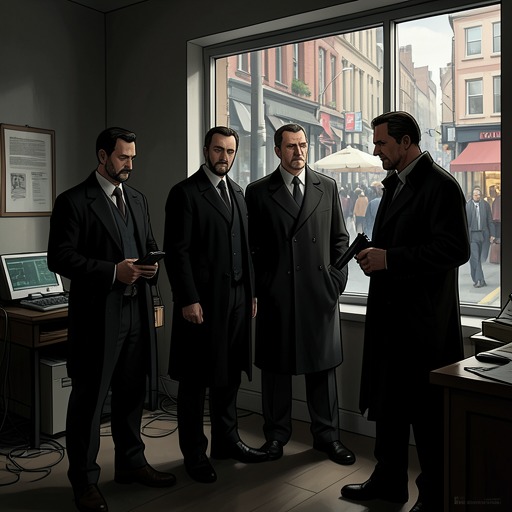
The LAPD’s Internal Code of Trust and Anti-Informing
Inherent ViceThe LAPD’s Internal Code of Trust and Anti-Informing is the unwritten rule that makes occupational loyalty a condition of police work and treats an officer’s betrayal of that loyalty as grounds for punishment. Its clearest expression is not a formal policy but a murder contract: the LAPD asks Adrian Prussia to kill Detective Vincent Indelicato, describing the target only as someone in violation of the code. The episode makes the rule’s central contradiction visible: trust is called indispensable, yet the institution that invokes it conceals its own motives and enforces loyalty through a private killer.
The Rule and Its Enforcement
Adrian has found a new occupation in the years after becoming a regular presence around Parker Center. He specializes in political targets, especially Black and Chicano activists and antiwar protesters, generally using baseball bats from his collection. The police tolerate his presence and use his services without necessarily knowing his name. Violence against political opponents has become, for Adrian, a settled line of work; the request to target a detective unsettles that familiar arrangement.
When the LAPD approaches him about killing one of its own, Adrian says that the assignment lacks the usual appeal unless he is missing something. His contact answers by invoking the rule: “On the job,” there has to be trust, and everything depends on it. The explanation offers no account of the alleged breach itself. The detective is simply said to be “in violation,” and when Adrian asks whether he is a federal informant, the contact declines to discuss details. The code is therefore presented as an absolute principle while its application remains deliberately opaque.
Indelicato, Adrian, and Puck
The named target is Vincent Indelicato. Adrian recognizes him not only as a detective but as a customer who has borrowed from AP Finance and consistently paid both principal and interest on time. In the financial relationship Adrian can verify, Indelicato is dependable. The LAPD’s unnamed allegation, by contrast, comes without particulars. That gap between the private lender’s direct experience and the institution’s guarded claim makes the label of betrayal impossible to assess independently.
Adrian also knows that Puck Beaverton hates Indelicato from long before the assignment. Indelicato had recently arrested Puck for a minor offense involving a pot seed, and Puck is out on bail awaiting sentence. The LAPD’s appeal to police solidarity thus intersects with a personal grievance that can do the practical work of recruiting a gunman. Adrian first tries to stir up the same lethal indignation he has felt toward activists and pornographers, but finds that his heart is not in it. He summons Puck and presents the proposed involvement as an attempt to help with Puck’s arrest, bringing a personal enemy into a killing framed as an institutional necessity.
Informants and Competing Accounts
The episode belongs to a larger landscape in which informant status is both a security concern and a tool of official storytelling. Federal agents question Doc Sportello about Tariq Khalil, whom they identify as a known Black prison militant. They lay out a suggestive chronology: Khalil visits Doc, an acquaintance of Khalil’s is killed the following day, Mickey Wolfmann disappears, and Doc is arrested on suspicion. Doc counters that he was released and redirects the agents to Bigfoot Bjornsen, who has the case file.
Doc then speculates that, once a disappearance passes the twenty-four-hour threshold, federal authorities may be considering a kidnapping narrative that could attribute Wolfmann’s abduction to a Panther operation. The agents exchange a nervous look. Their reaction does not establish that Doc’s theory is correct, but it shows how quickly an official account can be imagined as cover, and how a supposed political motive might be useful to investigators. The same distinction between a declared reason and a concealed purpose shadows the LAPD’s explanation of Indelicato’s violation.
Coy Harlingen’s experience makes the informant problem more intimate. Recruited into Vigilant California and sent to infiltrate antiwar, antidraft, and anticapitalist groups, he eventually realizes that the self-described patriots who direct him are themselves being directed by a higher level of power. His handlers have classified him as an “addictive personality” and count on his difficulty leaving informant work, just as he struggled to leave heroin. In a separate conversation with Doc, Coy observes that people sometimes ask questions whose answers they already know, wanting to hear them from another voice. That insight describes the method of intelligence work as well as its atmosphere: information is not merely gathered but elicited, tested, and made to serve an existing account.
Loyalty as an Institutional Double Standard
The code’s moral vocabulary is sharply at odds with the conduct of the system that cites it. The LAPD has Adrian, an outside contractor, perform violence against a detective, while withholding the alleged facts that would make the target’s supposed betrayal intelligible. Police loyalty is treated as absolute when demanded of an officer, but the institution does not answer to the same standard of openness or accountability. The code therefore functions less as a transparent rule than as a controlled designation: those in authority can identify a violation without explaining it, then arrange its punishment beyond ordinary police procedure.
This structure echoes the wider novel’s scrutiny of power over information and place. The agents’ attention to Black political groups coexists with Doc’s suspicion that federal interest in Wolfmann may have another purpose. Elsewhere, the landscape of Los Angeles bears the consequences of decisions narrated as development: Tariq describes the wartime removal of Japanese residents from South Central and the arrival of Black residents in their place, while the history of land use links that displacement to the clearance of neighborhoods for new projects. At Channel View Estates, the language of a Michael Wolfmann concept overlays the loss of the older neighborhood. These different episodes are not evidence of a single conspiracy, but they share a political atmosphere in which institutions classify people, justify interventions, and leave the people affected to infer the concealed interests behind them.
The LAPD’s code gives that atmosphere a compact and violent form. It promises that police work depends on trust, yet the reader sees trust invoked by a secretive superior, applied to a detective whose actual conduct remains unspecified, and enforced through an intermediary already bound to the target by private debt and hostility. The rule’s power is not that it resolves what Indelicato did; it is that the institution can make an accusation of disloyalty sufficient to put him in danger.